
Air Supply – Sweet Dreams
Amidst a sea of syrupy love ballads, a prog-rock earworm emerges
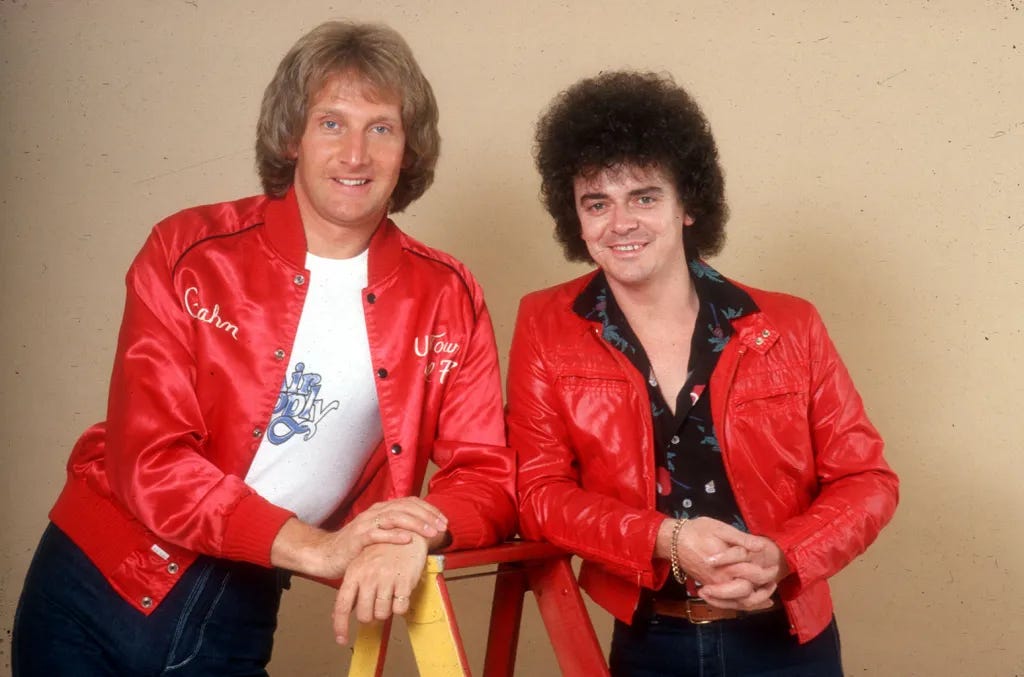
I’ve been on a bit of an Air Supply binge lately (no, you don’t have to give me those pitying looks), since contemplating my 10 answers to the questions Mark Nash offered me for his fantastic Personal Mixtape series. I’ll be his guest next week, and if you don’t subscribe to his newsletter (you should!), I’ll cross-post the interview to my subscribers as well.
Anyway, one of the questions got me thinking about the very first concert I attended with my parents: Air Supply at (I think) the Hollywood Bowl. I was pretty familiar with their music, as my dad had all their records, and the band’s 1980 album Lost in Love seemed to be playing at our house on a daily basis. The hits from that album, “Lost in Love” and “All Out of Love,” were ubiquitous on soft–rock radio, so there was no getting away from the “lost in lush” dual vocals of Russell Hitchcock and Graham Russell.
I don’t remember a single thing about that concert, other than that I was definitely not into it. Sappy love songs were the antithesis of what this preteen boy wanted to listen to at that time. I was a burgeoning headbanger, preferring my Australians to sound and look more like my new favorite band, AC/DC. I would get to see them in concert a few years later — a show I definitely/sorta remember.1
I’ve come to appreciate Air Supply and soft rock in general as I’ve become a man of a certain age, watching my parents in their final years, wishing I could save time in a bottle. When Neil Sedaka recently passed, I listened to only Sedaka songs on the six-hour drive from my home in Northern California to visit my folks in Southern California. I wrote about this experience in a recent essay that you can read below.

While I will argue that “All Out of Love” is a banger of the softest, sweetest order, the song that is stuck in my head this week is from their follow-up album, The One That You Love. Those fun-loving Aussies certainly love love, and were never afraid to (over)use the word in their songs and album titles.
Two unavoidable ballads from this album, which kept their chart-topping flame burning strong for another year, were “Here I Am (Just When I Thought I Was Over You)” and, of course, their smash #1 hit, “The One That You Love,” which surely was slow-danced to by newlyweds at thousands of weddings around the globe.
If you didn’t have the great privilege of growing up in the Air Supply heyday, you really missed out on these gems. That’s why I follow the famous Spiderman credo: with great age comes great responsibility. And will do my part to make sure the younger generations get their proper supply of air.
When I jumped into this soft rock rabbit hole, I wasn’t interested only in the hits. I wanted to explore the deep cuts. Was Air Supply simply a love song hit machine? There’s nothing wrong with that, but I sensed something more. What gems might I unearth if I dug deeper into their vast catalog?
I decided to start with the band’s Arista era, when the great Clive Davis (RIP) brought Air Supply over to his label after hearing the aforementioned “All Out of Love.” None of the band’s previous records triggered any childhood memories, although “Love and Other Bruises,” a top-10 hit in 1976 in their native Australia, did ring a faint bell.
The Lost in Love album did surprise me a bit, with a fun disco-tinged tune titled “Just Another Woman,” that I can imagine having a bit of success on a dance floor or two. But I was looking for something more daring. Something with more muscle. “Old Habits Die Hard” had a nice country twang, but it was never going to get them invited to the Grand Ole Opry.
I would need to dig a little deeper to find the sonic glory I was looking for.
I began to worry when the first five tunes off 1981’s The One That You Love were over-loaded with schmaltz. Even though I’m lactose intolerant, I’m extremely tolerant to cheese when it comes in music form. To use a pizza metaphor, I can handle three or four slices, but after that, I’m gonna have to run to the bathroom.
Thankfully, track #6 brought the meat and potatoes (mixed metaphor? Or a bold pizza-topping choice?).
Instead of the expected wall of syrupy strings, “Sweet Dreams” brought a heaping spoonful of salty-bitter Vegemite. Probably not a great pizza topping.
The song begins with the sound of ocean waves. Gentle waves, perhaps, but soon an ominous keyboard warning drone, accompanied by a hypnotic minor-key guitar line, brings dark, foreboding energy. This is punctuated by some eerie, deep organ notes. Maybe it’s just me, but I’m getting strong Black Sabbath vibes. I half expect Ozzy’s sinister nasal voice to appear. That it doesn’t is only slightly disappointing.
After a minute of nervous, expectant swelling, the instruments swoosh out, and we are left with just piano, and Graham Russell’s delicate voice intoning:
This is the time / When you need a friend / You just need someone near / I’m not looking forward / To the night I’ve spent / Thinking of you when you’re not here
Okay, we’re back on expected ground, I think. But I’m wrong. Well, partially wrong.
Instead of Black Sabbath, I’m getting strong notes of Cornerstone-era Styx. Like the two Grahams have channeled the great Dennis DeYoung and Tommy Shaw.
I mean, is Styx’s “Babe” all that different from Air Supply’s “Making Love Out of Nothing at All”? Both are ballads about being on the road and missing your lover. Is this triggering an idea for a Five For Friday topic, Emm as in Music?
It’s the chorus that is my favorite part of the song, when Russell Hitchcock croons, “Close your eyes, I want to see you tonight in my sweet dreams.” The strings, instead of drowning the song, create a bed for it to float upon. It’s what Keith Emerson, Rick Wakeman, and Tony Banks have provided on the best tracks from ELP, Yes, and Genesis.2
I also want to highlight the lush and tasteful guitar solo from the one and only Steve Lukather (of Toto fame). I won’t lie: it gives me chills. In fact, if you do dive deeper into the Air Supply oeuvre, pay attention to the stellar musicianship throughout. It’s undeniable.
Apparently, “Sweet Dreams” was the 3rd single from The One That You Love, and in 1982, reached #5 on the Billboard Hot 100. I don’t recall hearing it on the radio back then, but as I mentioned earlier, I was knee-deep in my hard rock/heavy metal years.
So this is hardly a deep cut, and the song is/was rarely left off the set list at their concerts (which are still going strong!). In fact, it’s a track that the band loved to highlight, with expanded orchestration, as illustrated in the video below.
You might hear this and say that “Sweet Dreams” is about as Prog as Barry Manilow’s “Copacabana” is a Brazilian samba or bossa nova. And you would be right.3
We all make our connections as we see them.
I personally get some serious Alan Parsons Project vibes when I listen to it; I’m transported to that Eye in the Sky, where I am able to finally relax, close my eyes, and ride the skies in my sweet dreams.

Thanks for reading, y’all!
I know Air Supply is not everybody’s cup of tea, but hopefully this meandering journey through a small portion of Air Supply’s “supply” brought you a bit of joy and not too much nausea.
Do you have any Air Supply stories? A favorite tune? A favorite soft-rock song?
Maybe I didn’t fully achieve a solid prog-rock soft-rock connection, but I can always write a part 2!:)
The show started with 8 schoolboy-attired Angus Youngs appearing one by one on a 3-story tic-tac-toe-shaped stage, the real Angus finally appearing in the center square. The crowd went absolutely nuts.)
Yes, I’m trying to be provocative here.
Clive Davis also brought Mr. Manilow to global prominence.
Sweet Dreams is epic. Your comparison to Styx is right on. Love these guys. Such incredible vocalists. Bring on the cheese.
So, a few things. This has a prog influence and i think you are right to cite Styx and Parsons. It is more what i call prog pop, which is really splitting hairs, but i know some folks turn their noses up when you dare say something like this is prog. And yet, it has the bones and the ambition. If anything, it reminds me a bit of early Ambrosia, pre-soft rock breakthrough, when they worked with, yup, Parsons. At the same time, i hear Boston's Amanda in here. So, that is a long-winded way of saying that i don't think you are making love out of nothing at all. PS: you could do a bunch of long-distance songs like this that are rock coded-Can't Hardly Wait by the 'mats, Nobody Home by Floyd--or otherwise--Western Skies by Freedy Johnston--and you'd have a nifty 54F, if you are game. And if so, the welcome mat is out...